
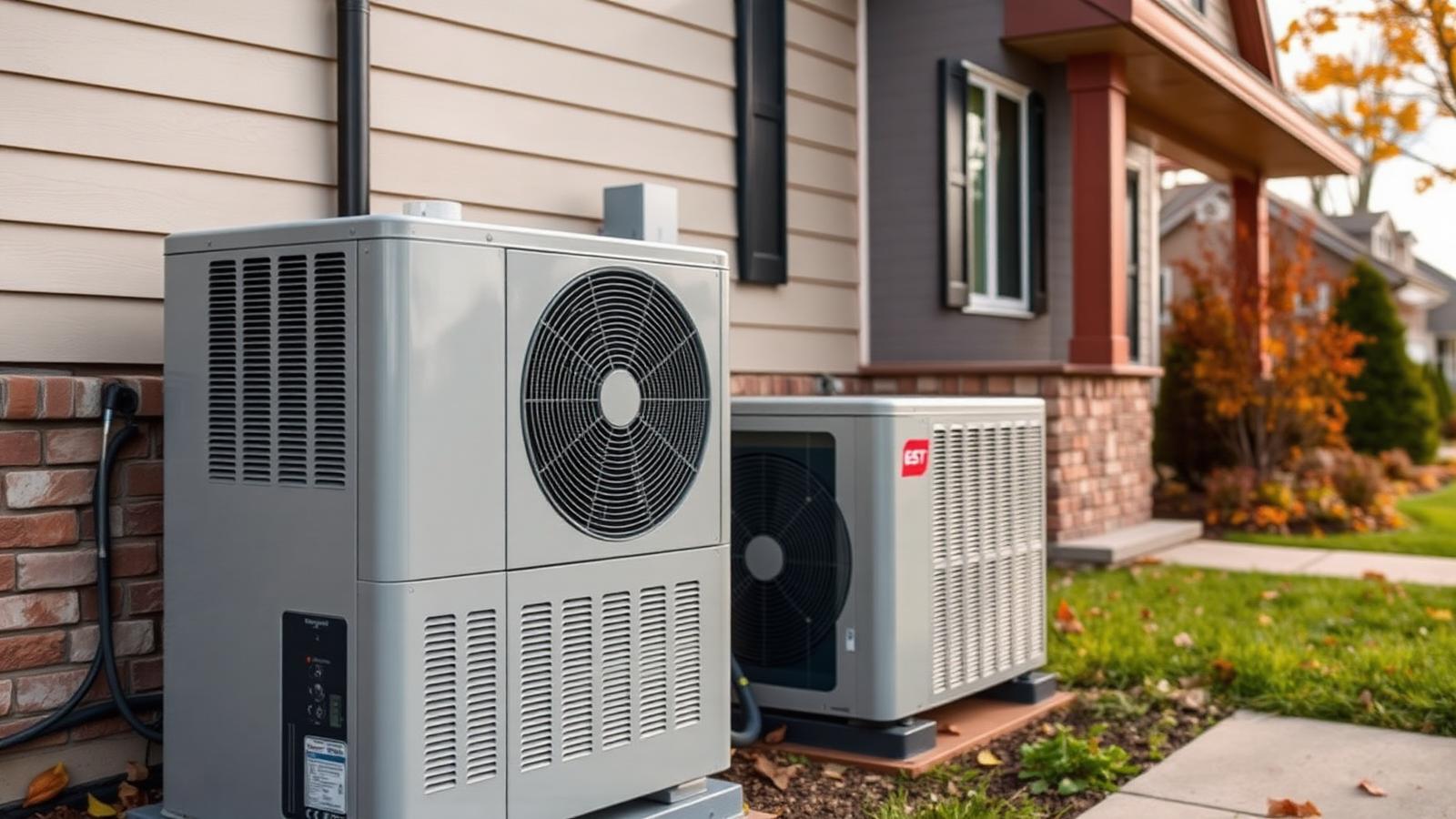
What Is a Heat Pump, in Plain English?
A heat pump is a single outdoor unit that heats and cools your home using electricity. It does not burn gas. Instead, it moves heat from one place to another, the same way your refrigerator moves heat out of the food compartment.
In summer, it works like a central air conditioner, pulling heat out of your house and dumping it outside. In winter, it runs in reverse and pulls heat out of the cold outdoor air and brings it inside. Yes, even 20 degree air still contains usable heat.
Because it moves heat instead of creating it, a modern heat pump delivers about 2 to 4 units of heat for every 1 unit of electricity it uses. A gas furnace, by comparison, can never deliver more energy than the fuel you put into it.
How Does a Heat Pump Actually Work?
Every heat pump has four main parts: a compressor, an outdoor coil, an indoor coil, and refrigerant that cycles between them. A reversing valve flips the refrigerant direction to switch between heating and cooling.
- Cooling mode. Refrigerant absorbs heat from your indoor air, the compressor squeezes it hot, and the outdoor coil releases that heat to the outside air.
- Heating mode. The valve reverses. The outdoor coil now absorbs heat from outside air, the compressor concentrates it, and the indoor coil releases that heat into your home through your existing ductwork.
You keep the same thermostat, the same ducts, and the same air handler location as a traditional furnace and AC. What changes is what sits outside and how the indoor unit is configured.
Do Heat Pumps Really Work in Illinois Winters?
This is the number one question we hear, and the short answer is yes, if you buy the right one.
Older heat pumps struggled below about 30 degrees. Modern cold-climate heat pumps using variable-speed inverter compressors hold rated capacity down to around 5 degrees and keep producing usable heat well below zero. According to the U.S. Department of Energy, today's cold-climate heat pumps can heat homes efficiently even in sub-zero temperatures.
Central Illinois averages a January low around 17 degrees, with occasional cold snaps into the negatives. For those coldest stretches, most homeowners here choose one of two setups:
- Dual-fuel (hybrid). The heat pump handles most of the winter. Your existing gas furnace kicks in only on the coldest days when it is cheaper per BTU than the heat pump. This is the most popular choice in our service area.
- All-electric with backup strips. A cold-climate heat pump with electric resistance backup for extreme cold. Best for homes without an existing gas line or homeowners moving away from gas entirely.
How Much Does a Heat Pump Cost in Central Illinois in 2026?
Installed pricing depends on your home size, the efficiency tier, whether you need duct or electrical work, and whether you go single-stage, two-stage, or variable-speed. These are the ranges we see across Pekin, Peoria, Morton, and Washington in 2026:
- Standard efficiency (14.3 SEER2, single-stage), 2-3 ton: $6,500 to $9,500 installed
- Mid-tier (16-17 SEER2, two-stage), 2.5-3.5 ton: $9,500 to $13,500 installed
- Cold-climate variable-speed (18+ SEER2, inverter), 3-4 ton: $13,500 to $18,500 installed
- Dual-fuel package (heat pump plus new 96% gas furnace): $12,500 to $19,500 installed
For comparison, a new traditional furnace and AC combo runs roughly $9,000 to $16,000 depending on efficiency and size. For a full breakdown of AC pricing, see our new AC cost by home size guide.
Add-ons that can change your quote: replacing a badly matched line set, electrical panel upgrades, new thermostat that supports dual-fuel, ductwork sealing, or moving the outdoor pad.
What Federal Tax Credits and Utility Rebates Are Available in 2026?
Heat pumps are one of the most heavily incentivized home upgrades in the country right now.
- Federal tax credit (25C). Up to $2,000 back on your federal taxes for a qualifying ENERGY STAR cold-climate heat pump. See the current program details at the ENERGY STAR federal tax credit page.
- Ameren Illinois rebates. Ameren offers utility rebates on qualifying high-efficiency heat pumps and smart thermostats through their Energy Efficiency Program. Amounts change each year, so we check the current rebate table before we quote.
- Illinois Home Efficiency Rebates (HOMES/HEAR). Illinois' rollout of the federal IRA-funded rebate programs is expanding income-qualified rebates up to $8,000 on a heat pump install. Availability depends on household income and program funding.
Combined, a well-timed install can knock $2,000 to $10,000 off the sticker price. We help you file the paperwork.
How Does a Heat Pump Compare to a Furnace and AC?
Here is what most Central Illinois homeowners actually save when they switch a 15+ year old furnace and AC to a modern dual-fuel heat pump setup:
- Cooling season: 20-40% lower electric bills from a 16+ SEER2 rating versus an old 10-12 SEER unit.
- Shoulder seasons (Oct-Nov, Mar-May): 30-50% lower heating costs versus running the gas furnace, because the heat pump is far more efficient than the furnace in mild weather.
- Deep winter: The gas furnace still takes over on the coldest days, so no efficiency penalty during a polar vortex.
Real-world payback for a dual-fuel upgrade typically lands in the 7 to 12 year range in our climate, before rebates. After rebates, we've seen payback drop under 5 years. Equipment life is 15-20 years with proper maintenance.
What Do SEER2 and HSPF2 Ratings Mean?
In 2023, the federal government changed how heat pumps are rated. You will see two numbers on every quote:
- SEER2 measures cooling efficiency. Higher is better. Illinois minimum is 14.3 SEER2. Premium systems reach 18-22 SEER2.
- HSPF2 measures heating efficiency. Higher is better. Look for 8.1 HSPF2 or higher for solid cold-weather performance. Cold-climate models reach 10+ HSPF2.
Also new in 2025: all systems now use A2L refrigerant (R-454B or R-32) instead of the older R-410A. This is a lower-global-warming refrigerant required by federal rule. Any system installed today should be A2L compatible. Do not buy leftover R-410A stock unless the price reflects an outgoing product.
Is a Heat Pump Right for Your Home?
A heat pump is usually the smart move when:
- Your furnace and AC are both 12+ years old (you get one system instead of two).
- You are seeing rising natural gas bills and want to hedge.
- Your home has decent insulation and reasonably tight windows.
- You qualify for the federal 25C credit and Ameren rebates.
- You want a quieter, more even heat than a single-stage gas furnace.
It is usually not the best move when:
- Your existing furnace is under 8 years old and working fine.
- Your home is severely under-insulated (fix that first, then reconsider).
- Your electric service panel is undersized and would require major upgrades.
If you are on the fence, a dual-fuel heat pump installation is often the best of both worlds for our climate.
How Does Trouble Free Size and Quote a Heat Pump?
We do not size heat pumps off the back of a napkin. Bad sizing is the number one cause of high bills and comfort complaints on new systems.
Every quote starts with an in-home visit. We measure your conditioned square footage, check insulation levels, look at duct condition and static pressure, evaluate your electrical panel, and confirm outdoor placement clearances. That gives us a proper Manual J load calculation so the equipment matches your home instead of matching a rule-of-thumb.
Then we walk you through your options in plain English: single-stage vs. two-stage vs. variable-speed, straight heat pump vs. dual-fuel, brand and warranty differences, rebate stacking, and financing. You get one clear installed price. No hourly games, no surprise line items on installation day.
We install and service heat pumps across Pekin, Peoria, Morton, Washington, East Peoria, Canton, Mackinaw, Tremont, and North Pekin.
To keep your home trouble-free, call (309) 347-5309 or request your free in-home heat pump estimate.